The Art of the Ridiculous Sublime on David Lynchs Lost Highway

Slavoj Žižek's The Fine art of the Ridiculous Sublime: On David Lynch's Lost Highway past Rachel Kushner
Role of the Editor's Choice series.

When I beginning saw David Lynch'due southLost Highway upon its theater release in 1998, I found myself seduced past what have get classic Lynchean touches: the opening sequence of bifurcated highway strip, its noirish titles, its lushly choreographed scenes and hearty use of the sexual and the grotesque—in sum, its unimpeachable stylishness. Just because of its elliptical plot and a nagging sense that Lynch had constructed a consummate but wholly abstruse teleology, combined with the fact that for several days after seeing the motion picture I compulsively spooked myself by imagining the disturbingly unwholesome Mystery Man (played past Robert Blake), with his cake flour complexion and dark, glistening eyes, lurking behind diverse doors in my apartment, I put an end to the torture and dismissedLost Highway from further contemplation.
Only after reading Slavoj Žižek's virtually recent Lacanian foray into popular civilization,The Art of the Ridiculous Sublime: On David Lynch'south Lost Highway, my interest in the film has been invigorated. Žižek makes sense of the narrative's Möbius-like temporal loop, in which the central grapheme Fred (Bill Pullman), obsessed with his possibly-unfaithful wife (Patricia Arquette), a tacit brunette from an aseptic suburban landscape, murders her then fantasizes that he is some other person (Balthazar Getty), who is seduced by a smoldering and disingenuous blonde, also played by Patricia Arquette. In his explorations of Lynch and other popular culture references that elaborate upon the Lacanian Real, Žižek uses New Age interpretations that dismiss meaning and focus on the artful and experiential qualities of the film to counterpoint his own. Although he never really makes clear who these "New Age obscurantists" are, I assume Žižek is referring to theorists who go on to invoke Jungian ideas.
Žižek's bones premise regarding the notion of 'ridiculous sublime' is that Lynch is able to construct ludicrous moments whose brilliance and effectiveness lie in the fact that they are to be taken completely seriously. And part of the joy of reading Žižek's study is a like feeling, that he is ready to take Lynch wholly seriously—not just because of the fact thatLost Highway readily invites Lacanian interpretations, but because information technology'due south terrific fun. Lynch's filmic intersection of the pyrophoric German language band Rammstein with California's Expiry Valley was an artistic conclusion this writer responded to with a simple "Hell aye!" But now Žižek has confirmed that "the musical accompaniment in the film is crucial," and that Rammstein "renders the universe of the utmost jouissance sustained by obscene superego injunction." Of class, there'due south nothing incorrect with the semiotics of a simple "Hell yeah," but venturing into Žižek's theoretical framework provides a satisfying complement. And for those who didn't care for the film (or for Rammstein, for that matter) Žižek's written report is a marvelous and reader-friendly schematic of difficult Lacanian theories, rendered with lucid intendance and an intellectually generous, exuberant tone.
The Art of the Ridiculous Sublime: On David Lynch's Lost Highway was published in the autumn of 2000 by the Walter Chapin Simpson Center for the Humanities.
Related
The German philosopher holds forth on dearest, diagrams, and his item mode of oration. His volume Inconsistencies volition announced in English this autumn from MIT Press.
A collection of essays examining the cultural, social and political manifestations of both literal and metaphorical masquerade.
Geoffrey O'Brien and Luc Sante unearth the subtext that was Times Square in the '60s, "the round-the-clock festival of junk culture and lyrical sleaze."
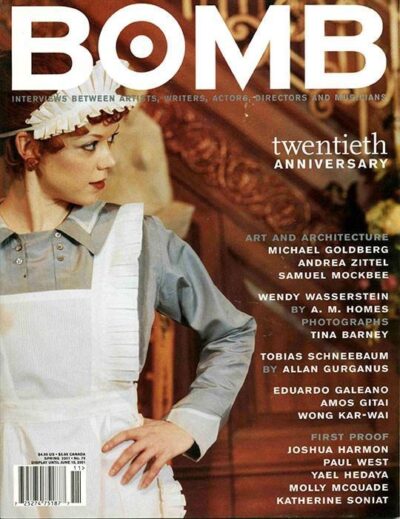
Originally published in
Featuring interviews with Wendy Wasserstein, Wong Kar-Wai, Amos Gitai, Eduardo Galeano, Tobias Schneebaum, Micheal Goldberg, Samuel Mockbee, Andrea Zittel.
I believe that each of us is given one sentence at birth, and we spend the balance of our life trying to read that sentence and make sense of it.
perreaultsciusurturs.blogspot.com
Source: https://bombmagazine.org/articles/slavoj-%C5%BEi%C5%BEeks-the-art-of-the-ridiculous-sublime-on-david-lynchs-lost-highway/
0 Response to "The Art of the Ridiculous Sublime on David Lynchs Lost Highway"
Post a Comment