A Small Spontaneous Though Is That America Is a 3rd World Haven Until Collecting Ones Self Again
one. Your perspective on yourself is distorted.
Your "self" lies before y'all similar an open book. Only peer inside and read: who you are, your likes and dislikes, your hopes and fears; they are all at that place, ready to be understood. This notion is popular but is probably completely false! Psychological research shows that we do not accept privileged access to who we are. When we effort to assess ourselves accurately, we are really poking around in a fog.
Princeton University psychologist Emily Pronin, who specializes in human cocky-perception and decision making, calls the mistaken belief in privileged admission the "introspection illusion." The style we view ourselves is distorted, but we do not realize it. As a result, our self-image has surprisingly lilliputian to practice with our actions. For example, nosotros may be absolutely convinced that nosotros are compassionate and generous merely notwithstanding walk right past a homeless person on a cold day.
The reason for this distorted view is quite simple, according to Pronin. Because we do not want to be stingy, arrogant or self-righteous, we assume that we are non any of those things. As evidence, she points to our divergent views of ourselves and others. We take no trouble recognizing how prejudiced or unfair our role colleague acts toward some other person. But nosotros do not consider that nosotros could carry in much the aforementioned way: considering nosotros intend to be morally proficient, it never occurs to the states that we, as well, might be prejudiced.
Pronin assessed her thesis in a number of experiments. Amongst other things, she had her study participants complete a test involving matching faces with personal statements that would supposedly assess their social intelligence. Afterward, some of them were told that they had failed and were asked to name weaknesses in the testing procedure. Although the opinions of the subjects were almost certainly biased (not only had they supposedly failed the test, they were also being asked to critique it), most of the participants said their evaluations were completely objective. Information technology was much the same in judging works of art, although subjects who used a biased strategy for assessing the quality of paintings nonetheless believed that their ain judgment was balanced. Pronin argues that we are primed to mask our own biases.
Is the word "introspection" merely a nice metaphor? Could it be that we are non really looking into ourselves, as the Latin root of the word suggests, simply producing a flattering cocky-epitome that denies the failings that we all take? The research on self-knowledge has yielded much evidence for this conclusion. Although we recall we are observing ourselves clearly, our self-image is affected by processes that remain unconscious.
2. Your motives are ofttimes a complete mystery to you.
How well do people know themselves? In answering this question, researchers meet the following trouble: to appraise a person's self-image, one would accept to know who that person really is. Investigators employ a variety of techniques to tackle such questions. For example, they compare the cocky-assessments of exam subjects with the subjects' behavior in laboratory situations or in everyday life. They may ask other people, such as relatives or friends, to assess subjects as well. And they probe unconscious inclinations using special methods.
To measure unconscious inclinations, psychologists can apply a method known every bit the implicit clan examination (IAT), adult in the 1990s by Anthony Greenwald of the Academy of Washington and his colleagues, to uncover hidden attitudes. Since then, numerous variants have been devised to examine anxiety, impulsiveness and sociability, amid other features. The approach assumes that instantaneous reactions require no reflection; every bit a result, unconscious parts of the personality come to the fore.
Notably, experimenters seek to decide how closely words that are relevant to a person are linked to certain concepts. For example, participants in a written report were asked to printing a key every bit quickly as possible when a give-and-take that described a characteristic such as extroversion (say, "talkative" or "energetic") appeared on a screen. They were besides asked to printing the aforementioned primal as soon as they saw a discussion on the screen that related to themselves (such as their own name). They were to press a dissimilar cardinal as soon equally an introverted feature (say, "tranquility" or "withdrawn") appeared or when the discussion involved someone else. Of class, the words and key combinations were switched over the class of many test runs. If a reaction was quicker when a word associated with the participant followed "extroverted," for instance, information technology was assumed that extroversion was probably integral to that person's self-paradigm.
Such "implicit" self-concepts generally correspond only weakly to assessments of the cocky that are obtained through questionnaires. The image that people convey in surveys has footling to do with their lightning-fast reactions to emotionally laden words. And a person's implicit self-image is oftentimes quite predictive of his or her actual behavior, especially when nervousness or sociability is involved. On the other mitt, questionnaires yield better information about such traits as conscientiousness or openness to new experiences. Psychologist Mitja Back of the University of Münster in Germany explains that methods designed to elicit automatic reactions reverberate the spontaneous or habitual components of our personality. Conscientiousness and marvel, on the other hand, require a certain caste of thought and tin can therefore be assessed more than easily through cocky-reflection.
iii. Outward appearances tell people a lot well-nigh you.
Much research indicates that our nearest and dear oftentimes run across u.s. better than nosotros meet ourselves. As psychologist Simine Vazire of the Academy of California, Davis, has shown, two conditions in item may enable others to recognize who we actually are most readily: First, when they are able to "read" a trait from outward characteristics and, second, when a trait has a clear positive or negative valence (intelligence and creativity are obviously desirable, for instance; dishonesty and egocentricity are not). Our assessments of ourselves near closely match assessments by others when information technology comes to more neutral characteristics.
The characteristics generally virtually readable by others are those that strongly impact our beliefs. For example, people who are naturally sociable typically like to talk and seek out company; insecurity often manifests in behaviors such as hand-wringing or averting 1's gaze. In contrast, brooding is more often than not internal, unspooling inside the confines of one'due south mind.
We are frequently blind to the effect we have on others considering we simply practice non see our own facial expressions, gestures and body language. I am hardly aware that my blinking eyes bespeak stress or that the slump in my posture betrays how heavily something weighs on me. Because information technology is so hard to detect ourselves, we must rely on the observations of others, especially those who know u.s.a. well. It is hard to know who we are unless others let usa know how we touch them.
4. Gaining some distance tin assist you know yourself better.
Keeping a diary, pausing for self-reflection and having probing conversations with others accept a long tradition, but whether these methods enable us to know ourselves is hard to tell. In fact, sometimes doing the opposite—such as letting get—is more helpful because it provides some distance. In 2013 Erika Carlson, at present at the University of Toronto, reviewed the literature on whether and how mindfulness meditation improves one'due south self-knowledge. It helps, she noted, past overcoming two big hurdles: distorted thinking and ego protection. The practice of mindfulness teaches us to allow our thoughts to merely drift past and to place with them as niggling as possible. Thoughts, afterwards all, are "only thoughts" and non the absolute truth. Frequently, stepping out of oneself in this way and simply observing what the mind does fosters clarity.
Gaining insight into our unconscious motives tin can enhance emotional well-existence. Oliver C. Schultheiss of Friedrich-Alexander University of Erlangen-Nürnberg in Germany has shown that our sense of well-existence tends to grow as our conscious goals and unconscious motives get more than aligned or congruent. For case, we should not slave away at a career that gives us money and power if these goals are of little importance to united states. But how do we accomplish such harmony? By imagining, for example. Endeavor to imagine, as vividly and in as much item as possible, how things would be if your most fervent wish came true. Would it really make you happier? Often we succumb to the temptation to aim excessively loftier without taking into account all of the steps and effort necessary to achieve aggressive goals.

5. Nosotros as well frequently think we are amend at something than we are.
Are yous familiar with the Dunning Kruger outcome? It holds that the more incompetent people are, the less they are aware of their incompetence. The effect is named after David Dunning of the University of Michigan and Justin Kruger of New York University.
Dunning and Kruger gave their test subjects a series of cognitive tasks and asked them to estimate how well they did. At best, 25 pct of the participants viewed their operation more than or less realistically; merely some people underestimated themselves. The quarter of subjects who scored worst on the tests really missed the mark, wildly exaggerating their cerebral abilities. Is it possible that boasting and failing are two sides of the same coin?
Equally the researchers emphasize, their work highlights a general feature of self-perception: each of us tends to overlook our cognitive deficiencies. According to psychologist Adrian Furnham of University College London, the statistical correlation between perceived and actual IQ is, on average, but 0.16—a pretty poor showing, to put it mildly. By comparing, the correlation between height and sex is nearly 0.seven.
So why is the chasm between would-be and actual performance and then gaping? Don't we all take an involvement in assessing ourselves realistically? It surely would spare us a keen deal of wasted try and perhaps a few embarrassments. The answer, information technology seems, is that a moderate inflation of self-esteem has certain benefits. According to a review by psychologists Shelley Taylor of the University of California, Los Angeles, and Jonathon Brown of the University of Washington, rose-colored spectacles tend to increment our sense of well-being and our performance. People afflicted by depression, on the other hand, are inclined to be brutally realistic in their self-assessments. An embellished self-epitome seems to help usa weather the ups and downs of daily life.
6. People who tear themselves down feel setbacks more frequently.
Although virtually of our contemporaries harbor excessively positive views of their honesty or intelligence, some people suffer from the opposite distortion: they belittle themselves and their efforts. Experiencing contempt and belittlement in babyhood, often associated with violence and abuse, can trigger this kind of negativity—which, in turn, can limit what people tin can accomplish, leading to distrust, despair and even suicidal thoughts.
It might seem logical to think that people with a negative self-prototype would exist just the ones who would want to overcompensate. Yet as psychologists working with William Swann of the Academy of Texas at Austin discovered, many individuals racked with self-doubt seek confirmation of their distorted cocky-perception. Swann described this phenomenon in a study on delectation in marriage. He asked couples virtually their own strengths and weaknesses, the ways they felt supported and valued by their partner, and how content they were in the union. As expected, those who had a more positive attitude toward themselves plant greater satisfaction in their relationship the more they received praise and recognition from their other half. But those who habitually picked at themselves felt safer in their marriage when their partner reflected their negative image dorsum to them. They did non inquire for respect or appreciation. On the contrary, they wanted to hear exactly their own view of themselves: "Yous're incompetent."
Swann based his theory of self-verification on these findings. The theory holds that nosotros desire others to run across us the manner we see ourselves. In some cases, people actually provoke others to respond negatively to them and then as to prove how worthless they are. This behavior is non necessarily masochism. It is symptomatic of the want for coherence: if others respond to us in a way that confirms our self-image, and so the world is as it should exist.
Besides, people who consider themselves failures will go out of their way non to succeed, contributing actively to their own undoing. They will miss meetings, habitually fail doing assigned work and get into hot water with the boss. Swann'south approach contradicts Dunning and Kruger's theory of overestimation. Merely both camps are probably right: hyperinflated egos are certainly common, simply negative self-images are not uncommon.
7. You deceive yourself without realizing it.
Co-ordinate to one influential theory, our trend for self-deception stems from our want to print others. To appear convincing, we ourselves must be convinced of our capabilities and truthfulness. Supporting this theory is the observation that successful manipulators are often quite full of themselves. Good salespeople, for example, exude an enthusiasm that is contagious; conversely, those who dubiousness themselves mostly are not good at sweet talking. Lab inquiry is supportive as well. In 1 study, participants were offered money if, in an interview, they could assuredly claim to have aced an IQ examination. The more than try the candidates put into their performance, the more they themselves came to believe that they had a loftier IQ, even though their actual scores were more than or less boilerplate.
Our self-deceptions have been shown to be quite changeable. Often nosotros adapt them flexibly to new situations. This adaptability was demonstrated by Steven A. Sloman of Dark-brown Academy and his colleagues. Their subjects were asked to motility a cursor to a dot on a computer screen as quickly equally possible. If the participants were told that to a higher place-average skill in this chore reflected high intelligence, they immediately concentrated on the task and did improve. They did not really seem to think that they had exerted more effort—which the researchers interpret as evidence of a successful self-deception. On the other hand, if the examination subjects were convinced that only dimwits performed well on such stupid tasks, their performance tanked precipitously.
Only is self-deception even possible? Tin nosotros know something about ourselves on some level without being conscious of it? Absolutely! The experimental evidence involves the following research design: Subjects are played audiotapes of human being voices, including their own, and are asked to signal whether they hear themselves. The recognition rate fluctuates depending on the clarity of the audiotapes and the loudness of the background dissonance. If brain waves are measured at the same fourth dimension, item signals in the reading bespeak with certainty whether the participants heard their own vocalism.
Most people are somewhat embarrassed to hear their own vocalization. In a classic written report, Ruben Gur of the University of Pennsylvania and Harold Sackeim of Columbia University made employ of this reticence, comparison the statements of test subjects with their encephalon activity. Lo and behold, the action frequently signaled, "That'south me!" without subjects' having overtly identified a voice as their own. Moreover, if the investigators threatened the participants' self-image—say, by telling them that they had scored miserably on another (irrelevant) exam—they were even less apt to recognize their vocalism. Either mode, their encephalon waves told the real story.
In a more recent study, researchers evaluated performances on a practice test meant to help students assess their own cognition so that they could fill in gaps. Here subjects were asked to consummate as many tasks as possible within a set time limit. Given that the purpose of the practice test was to provide students with information they needed, it made little sense for them to cheat; on the contrary, artificially pumped-upwardly scores could have led them to let their studies slide. Those who tried to improve their scores by using time beyond the allotted completion menstruation would just be hurting themselves.
But many of the volunteers did precisely that. Unconsciously, they simply wanted to look skillful. Thus, the cheaters explained their running over fourth dimension past challenge to take been distracted and wanting to make up for lost seconds. Or they said that their fudged outcomes were closer to their "true potential." Such explanations, according to the researchers, misfile cause and result, with people incorrectly thinking, "Intelligent people commonly practise better on tests. So if I manipulate my test score past simply taking a fiddling more time than immune, I'thousand one of the smart ones, too." Conversely, people performed less diligently if they were told that doing well indicated a higher adventure for developing schizophrenia. Researchers call this miracle diagnostic cocky-deception.
eight. The "true self" is healthy.
Most people believe that they have a solid essential cadre, a true self. Who they truly are is evinced primarily in their moral values and is relatively stable; other preferences may change, but the truthful cocky remains the aforementioned. Rebecca Schlegel and Joshua Hicks, both at Texas A&M University, and their colleagues have examined how people'south view of their true cocky affects their satisfaction with themselves. The researchers asked test subjects to keep a diary well-nigh their everyday life. The participants turned out to experience most alienated from themselves when they had done something morally questionable: they felt particularly unsure of who they actually were when they had been dishonest or selfish. Experiments have also confirmed an association between the self and morality. When exam subjects are reminded of before wrongdoing, their surety about themselves takes a striking.
George Newman and Joshua Knobe, both at Yale University, accept found that people typically recall humans harbor a true self that is virtuous. They presented subjects with case studies of dishonest people, racists, and the like. Participants generally attributed the beliefs in the instance studies to environmental factors such as a difficult babyhood—the real essence of these people must surely have been unlike. This work shows our tendency to think that, in their heart of hearts, people pull for what is moral and good.
Another study past Newman and Knobe involved "Marker," a devout Christian who was nonetheless attracted to other men. The researchers sought to understand how the participants viewed Mark's dilemma. For bourgeois test subjects, Marker's "true cocky" was non gay; they recommended that he resist such temptations. Those with a more liberal outlook thought he should come out of the closet. Yet if Mark was presented as a secular humanist who idea being homosexual was fine but had negative feelings when thinking about aforementioned-sex couples, the conservatives quickly identified this reluctance equally evidence of Marker's true self; liberals viewed information technology every bit evidence of a lack of insight or sophistication. In other words, what we claim to exist the core of some other person'due south personality is in fact rooted in the values that we ourselves concord most dear. The "true self" turns out to be a moral yardstick.
The conventionalities that the true cocky is moral probably explains why people connect personal improvements more than than personal deficiencies to their "true self." Apparently nosotros do then actively to enhance appraisals of ourselves. Anne E. Wilson of Wilfrid Laurier Academy in Ontario and Michael Ross of the University of Waterloo in Ontario take demonstrated in several studies that nosotros tend to ascribe more negative traits to the person we were in the by—which makes us await better in the here and at present. According to Wilson and Ross, the farther back people go, the more negative their characterization becomes. Although comeback and change are part of the normal maturation procedure, information technology feels adept to believe that over time, ane has become "who ane really is."
Assuming that we have a solid core identity reduces the complexity of a world that is constantly in flux. The people around us play many different roles, acting inconsistently and at the same time standing to develop. Information technology is reassuring to think that our friends Tom and Sarah will be precisely the same tomorrow as they are today and that they are basically proficient people—regardless of whether that perception is right.
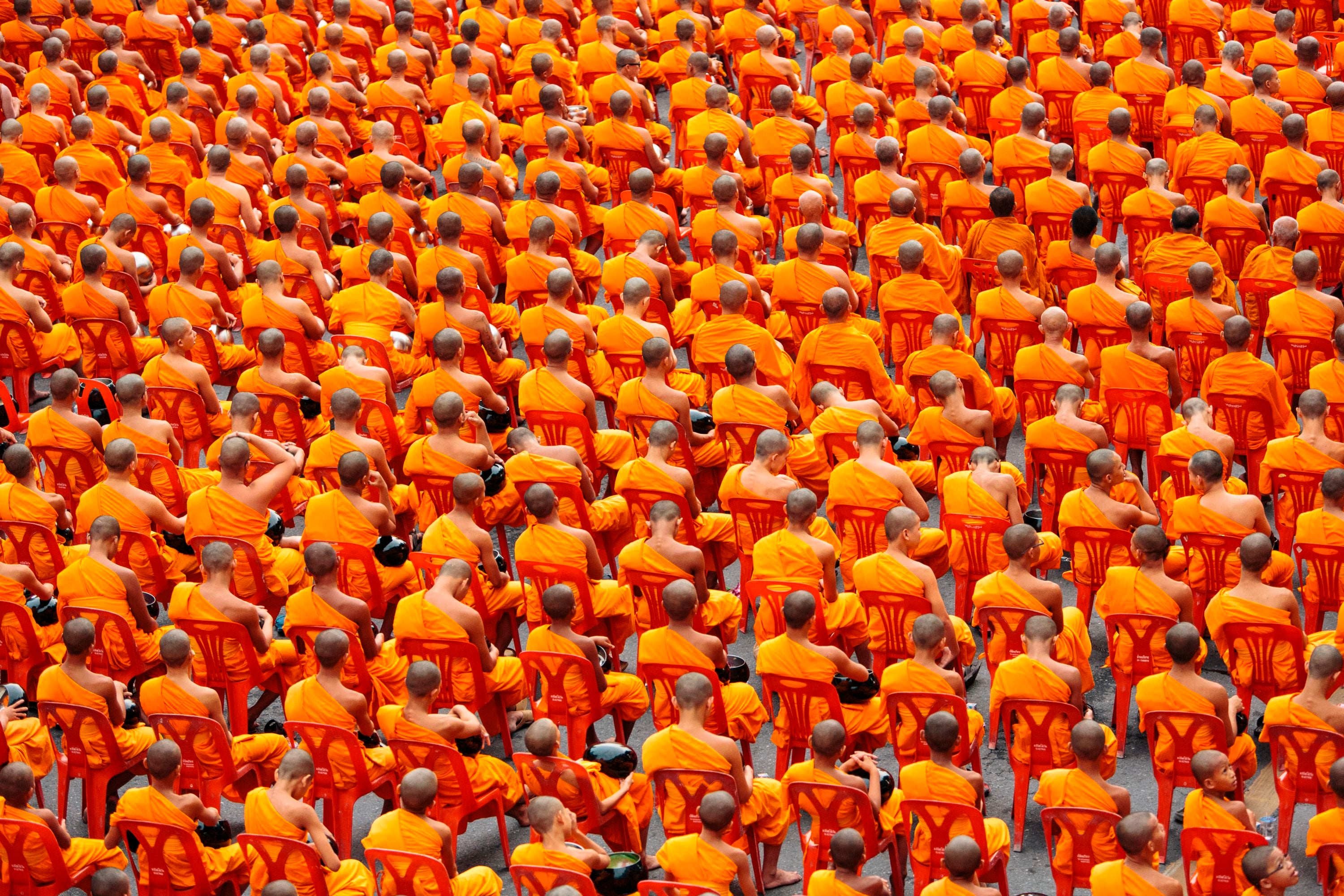
Is life without belief in a true self even imaginable? Researchers have examined this question by comparing different cultures. The belief in a true cocky is widespread in most parts of the earth. One exception is Buddhism, which preaches the nonexistence of a stable self. Prospective Buddhist monks are taught to see through the illusionary character of the ego—information technology is always in flux and completely malleable.
Nina Strohminger of the University of Pennsylvania and her colleagues wanted to know how this perspective affects the fear of death of those who concur it. They gave a series of questionnaires and scenarios to nearly 200 lay Tibetans and sixty Buddhist monks. They compared the results with those of Christians and nonreligious people in the U.S., as well as with those of Hindus (who, much like Christians, believe that a core of the soul, or atman, gives man beings their identity). The common image of Buddhists is that they are deeply relaxed, completely "selfless" people. Yet the less that the Tibetan monks believed in a stable inner essence, the more likely they were to fearfulness death. In improver, they were significantly more selfish in a hypothetical scenario in which forgoing a item medication could prolong the life of another person. About three out of four monks decided against that fictitious option, far more than the Americans or Hindus. Self-serving, fearful Buddhists? In another paper, Strohminger and her colleagues chosen the idea of the true self a "hopeful phantasm," admitting a mayhap useful ane. Information technology is, in whatsoever instance, 1 that is hard to shake.
9. Insecure people tend to behave more than morally.
Insecurity is generally thought of as a drawback, but it is not entirely bad. People who experience insecure nigh whether they have some positive trait tend to endeavour to bear witness that they do have it. Those who are unsure of their generosity, for case, are more than likely to donate money to a good cause. This beliefs can exist elicited experimentally by giving subjects negative feedback—for instance, "According to our tests, you are less helpful and cooperative than boilerplate." People dislike hearing such judgments and finish upward feeding the donation box.
Drazen Prelec, a psychologist at the Massachusetts Establish of Technology, explains such findings with his theory of self-signaling: what a particular action says about me is often more of import than the action'due south actual objective. More than a few people take stuck with a diet because they did not want to appear weak-willed. Conversely, it has been empirically established that those who are sure that they are generous, intelligent or sociable brand less effort to prove it. Too much cocky-balls makes people conceited and increases the chasm between the cocky that they imagine and the self that is real. Therefore, those who call back they know themselves well are specially apt to know themselves less well than they think.
10. If you retrieve of yourself as flexible, you will practice much better.
People'southward own theories well-nigh who they are influence how they acquit. One's self-epitome can therefore easily go a self-fulfilling prophecy. Carol Dweck of Stanford University has spent much fourth dimension researching such effects. Her takeaway: if we view a characteristic every bit mutable, we are inclined to work on it more. On the other hand, if we view a trait such equally IQ or willpower as largely unchangeable and inherent, we volition exercise little to improve it.
In Dweck'southward studies of students, men and women, parents and teachers, she gleaned a basic principle: people with a rigid sense of self take failure badly. They see it as prove of their limitations and fear it; fearfulness of failure, meanwhile, can itself cause failure. In contrast, those who empathise that a detail talent tin exist adult accept setbacks every bit an invitation to do better next time. Dweck thus recommends an mental attitude aimed at personal growth. When in doubt, we should assume that nosotros take something more to learn and that we can improve and develop.
But even people who accept a rigid sense of self are not fixed in all aspects of their personality. According to psychologist Andreas Steimer of the University of Heidelberg in Germany, even when people describe their strengths as completely stable, they tend to believe that they will outgrow their weaknesses sooner or later. If we effort to imagine how our personality will look in several years, we lean toward views such as: "Level-headedness and clear focus will still be part and parcel of who I am, and I'll probably take fewer self-doubts."
Overall, we tend to view our grapheme every bit more static than information technology is, presumably because this assessment offers security and direction. Nosotros want to recognize our particular traits and preferences and so that we tin can act appropriately. In the last analysis, the image that we create of ourselves is a kind of rubber oasis in an ever-changing world.
And the moral of the story? According to researchers, self-knowledge is even more difficult to attain than has been thought. Contemporary psychology has fundamentally questioned the notion that we tin know ourselves objectively and with certitude. It has made it articulate that the cocky is not a "thing" just rather a procedure of continual accommodation to changing circumstances. And the fact that we so often see ourselves equally more competent, moral and stable than we really are serves our ability to adapt.
perreaultsciusurturs.blogspot.com
Source: https://www.scientificamerican.com/article/10-things-you-dont-know-about-yourself/
0 Response to "A Small Spontaneous Though Is That America Is a 3rd World Haven Until Collecting Ones Self Again"
Post a Comment